How to trade memecoins with a $10 portfolio without letting fees eat the account
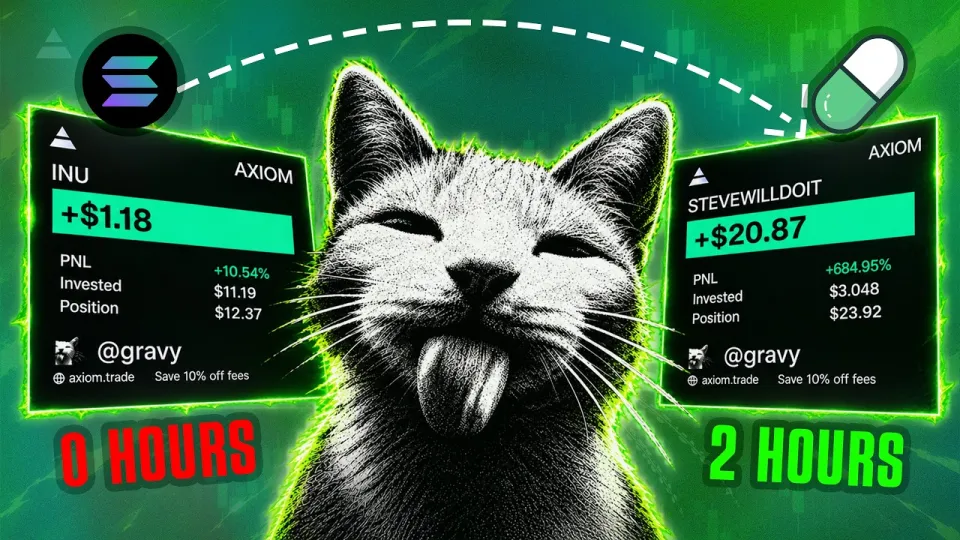
Video: I Tried Trading Memecoins with Just $10
Need articles like this for your video? They help promote it on YouTube and Google — order them in the Telegram bot @sat_sit_bot. Articles with your video embedded are written and posted by the bot itself — on popular topical sites (no ads). Your first 50 articles are free.
· based on the channel gravy
Key takeaways
- Five real memecoin trades on Solana, each buy capped at 0.05 SOL, are the basis of the gravy channel's $10 experiment.
- Tickers covered: STEVEWILLDOIT, NPC, MET (Meteora), PUMPY the Trader and UNTXD.
- The X Money meta trade is tied to the e/acc and Cream narrative cycle rather than to a chart pattern.
- Small size does not remove the fee problem: priority fees, slippage and Axiom's referral cashback change the math.
- One of the five trades was badly fumbled, which is the most useful lesson for anyone trading a sub-$20 balance.
Trading memecoins with $10 is possible on Solana, but only if every buy stays small (roughly 0.05 SOL), fees are treated as a real cost line and each position has an exit plan before entry. The gravy channel tested exactly this with five live trades, and the takeaway is that a tiny portfolio survives on discipline and narrative timing, not on size. You can follow the same route through Axiom's trading terminal, the platform used for the experiment.
What the $10 memecoin experiment actually tested
The premise was simple: critics say a small portfolio cannot trade memecoins because fees and taxes eat the gains, so the test ran five real trades with no single buy above 0.05 SOL. That cap matters more than the dollar figure, because Solana fees are fixed per transaction while your position size is not — a 0.05 SOL buy and a 5 SOL buy pay the same base network fee, but the small one pays a far larger share of its value. The five tickers were STEVEWILLDOIT, NPC, MET (Meteora), PUMPY the Trader and UNTXD, each bought for a stated narrative reason and sold for a stated reason. The honest part of the format is that one trade was fumbled badly, which is closer to the normal experience of a beginner than a clean five-for-five win streak.
Position sizing and fee math on a sub-$20 balance
On a $10 account, the fee structure decides whether a trade is worth taking at all, so size positions around costs rather than around conviction. Work through the numbers before you click buy:
- Convert your balance to SOL first. A $10 account is a fraction of one SOL, so think in SOL and let the dollar value drift.
- Cap each entry near 0.05 SOL, as the experiment did. That leaves room for several attempts instead of one all-in bet.
- Add up the round trip: base network fee, priority fee, the DEX or launchpad fee and slippage on both sides. On a tiny position these can consume a double-digit percentage before the price moves.
- Subtract the referral cashback you actually receive. Programs such as Axiom's referral perk reduce the effective cost, but they do not turn a bad entry into a good one.
- Set a minimum move you need just to break even, and skip any setup whose realistic target is below that threshold.
A practical rule: if the fees on a round trip equal 10% of your position, you need a 10% move to get flat, and the coin has to do that before the crowd exits. That is why small-account traders should prefer liquid pairs and avoid chasing illiquid launches where slippage alone can erase the trade.
The five trades and the narratives behind them
The experiment is a catalogue of memecoin meta-trading: each buy was justified by a story circulating on X, not by technical analysis. STEVEWILLDOIT rode a personality-driven meme; NPC played on the AI-versus-human joke that resurfaces whenever agent tokens trend; MET was a bet on the Meteora ecosystem name; PUMPY the Trader leaned on the pump.fun launch culture; UNTXD was a later, thinner setup. The X Money coin meta that ran during the session is the clearest example of how these cycles work — it was driven by the e/acc and Cream crowd, meaning a specific cluster of accounts amplified a narrative until liquidity arrived. For a small account the lesson is timing: you want to be in while the story is spreading and out before the timeline moves to the next ticker. Waiting for confirmation on a five-minute chart usually means buying the exit liquidity of faster traders.
Why narrative timing beats chart reading for small accounts
Memecoin prices on Solana follow attention, so the skill worth building is reading the feed rather than the candles. A workable process:
- Curate the timeline. Follow a small set of accounts that consistently surface new metas early, and mute the ones that only post after a coin has already run.
- Check who is amplifying. A ticker pushed by one loud account behaves differently from one echoed across several independent clusters.
- Look for the second wave. The first leg is often bots and insiders; the tradable window for a small buyer is frequently the retrace and re-acceleration, if the narrative is still alive.
- Time-box the trade. If the story has not attracted volume within your window, exit rather than hoping for a later pump.
- Accept that you will sell too early sometimes. Missing a further run costs nothing; holding a dead narrative costs the position.
This is also the answer to the most common frustration among small traders: buying a dip that never recovers, or selling a 20–40% loss only to watch the coin run later. Both usually come from entering after the narrative peak and from sizing so large that a normal drawdown feels unbearable.
Common questions from small-portfolio traders
Most doubts around trading memecoins with a tiny balance repeat the same few themes, and they deserve direct answers. People want to know whether $10 is enough, how to find coins with real narratives, whether to track profit and loss, and how to avoid rugs. On the first: yes, $10 is enough to practise execution, fee awareness and exits, but it is not enough to compound meaningfully — treat it as tuition. On narratives: build a short list of accounts and communities you trust, and note which clusters push which metas, because influence is concentrated. On tracking: log every entry, exit, fee and the reason for both, otherwise you cannot tell skill from luck. On rugs: check liquidity, holder concentration and whether the contract allows minting or freezes, and assume any launch under a few hours old can go to zero.
Mistakes that wreck a small memecoin account
The fastest way to lose a $10 balance is to abandon the sizing rule after a loss. Revenge sizing — doubling the next position to recover — turns a survivable drawdown into a wipeout, because the fee drag scales with every additional trade. The second killer is overtrading: ten round trips at a meaningful fee percentage can consume the account before any single bad call does. The third is copying entries without the exit: someone else's buy alert is not a plan, and by the time it reaches you the seller may already be filling orders. The fourth is ignoring slippage on thin pairs, where the quoted price and the filled price diverge enough to flip a winner into a loser. The fifth, visible in the experiment itself, is the fumbled trade — hesitating on the exit, then selling into weakness. Writing the exit condition down before entry is the cheapest fix available.
Useful links
- Axiom trading terminal with referral cashback
- The Trenches Discord community
- Discord with free Axiom imports and trade signals, not financial advice
- gravy on X
- Bitbase leverage trading with reduced futures fees
Conclusion
The $10 memecoin experiment is less a profit story than a demonstration that small accounts fail on costs and exits, not on capital. Keep each buy near 0.05 SOL, count the full round-trip fee before entering, trade narratives while they are still spreading and write the exit down first. The gravy channel deserves credit for showing the losing side of the process alongside the wins, which is rarer and more useful than another highlight reel. If you want to run the same setup, start through Axiom and keep the first month's goal at execution quality rather than returns.
Questions & answers
Is $10 actually enough to trade memecoins?
It is enough to learn execution, fee math and exit discipline, but not enough to build meaningful profit. Treat the balance as tuition: the goal is to complete trades correctly, log them and see how much of each move goes to fees and slippage.
How do I find memecoins with a good narrative?
Curate a short list of accounts and communities that surface metas early, and note which clusters push which tickers. A narrative is strongest while it is still spreading across several independent voices, and weakest once everyone in your feed has already posted it.
Why do I lose money even when I pick a coin that later runs?
Usually because the entry came after the narrative peak and the position was too large for a normal drawdown. Smaller size, a defined invalidation level and a time limit on the trade make it easier to hold through noise instead of selling at a 20–40% loss right before the bounce.
Should I track total profit and loss on a small account?
Yes, and per trade rather than only at the end. Record entry, exit, fees, slippage and the reason for both decisions, because on a small balance fees can quietly dominate the result and hide whether the strategy itself works.
Source: I Tried Trading Memecoins with Just $10 · Markdown version